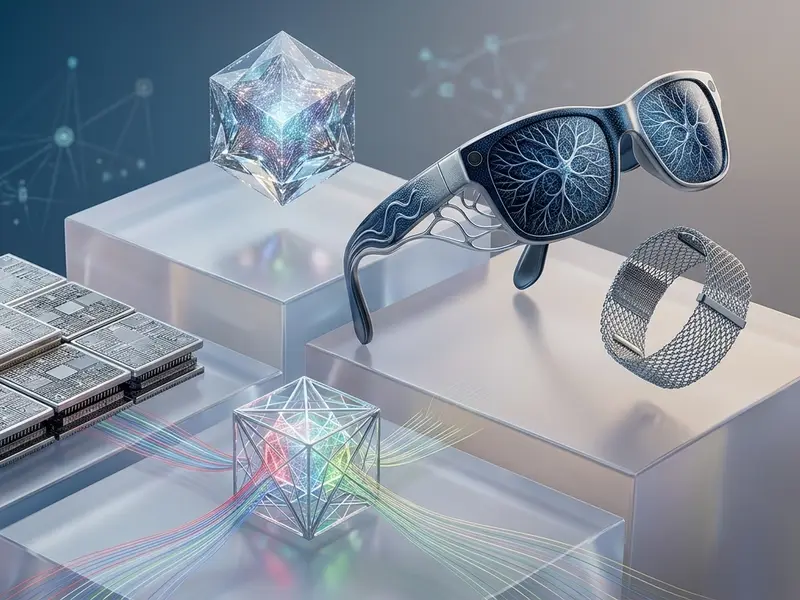
Technology Industry Searches for the Next Major Platform
Artificial-intelligence companies and consumer electronics manufacturers are intensifying efforts to develop wearable devices capable of putting AI assistance directly into everyday life.
Smart glasses, voice recorders, wearable assistants and other emerging devices are increasingly being positioned as possible alternatives — or complements — to smartphones.
The concept is straightforward: instead of repeatedly taking a phone from a pocket, users could communicate with an AI assistant through glasses, microphones or other wearable hardware.
The implementation is considerably more complicated.
Reuters reported that privacy concerns are emerging as one of the biggest challenges facing the developing market, particularly as companies experiment with products capable of recording audio, capturing images and analysing information about a user's surroundings.
That creates a fundamental question for the industry: how can a device understand a user's environment without making everyone nearby feel as though they might constantly be recorded?
Cameras Create Both Opportunity and Concern
Cameras can make AI wearables considerably more capable.
A wearable AI assistant equipped with a camera could potentially identify objects, read signs, translate text, provide navigation assistance or answer questions about what its user is seeing.
For consumers, those capabilities could make artificial intelligence more useful in everyday situations.
But the camera also introduces privacy concerns.
Unlike smartphones, which are usually visible when somebody takes a photograph or records a video, smart glasses can potentially make recording less obvious.
That difference has renewed questions about whether people nearby know when a device is recording and whether existing privacy laws adequately address increasingly sophisticated wearable technology.
Reuters reported that privacy concerns and legal scrutiny have become important challenges for the emerging sector, encouraging some companies to explore designs that provide users and bystanders with greater transparency.
Companies Explore Different Designs
Not every company is approaching wearable AI in the same way.
Some developers are focusing on camera-equipped glasses capable of understanding visual surroundings. Others are considering camera-free designs or devices that require deliberate user activation before recording.
These differences could become important competitive features.
Consumers may eventually evaluate AI wearables not only by battery life, appearance, processing capability and price, but also by how clearly the device communicates when it is collecting information.
Local processing could also become increasingly important.
Processing certain information directly on a device rather than automatically transmitting everything to remote servers can potentially reduce the amount of personal information leaving the hardware.
However, privacy protection depends on more than where processing occurs.
Companies also need policies governing data retention, user controls, security, access and whether information collected by AI devices is used for other purposes.
A Potential Post-Smartphone Market
The commercial opportunity explains why technology companies are continuing to invest despite the challenges.
Smartphones have dominated personal computing for more than a decade, creating an enormous global ecosystem of hardware manufacturers, software developers, advertisers and digital services.
A successful wearable computing platform could potentially reshape parts of that ecosystem.
AI has strengthened the argument for new hardware because conversational assistants can reduce dependence on traditional screens and menus.
Instead of opening an application, typing a query and reading results, a user could simply ask a wearable assistant a question.
Future systems could potentially combine voice interaction, visual recognition, translation, navigation and personalised assistance.
The result could be a computing experience that is more continuous and contextual than smartphone interaction.
Privacy Could Determine Consumer Adoption
Technological capability alone, however, does not guarantee widespread adoption.
Consumers also have to trust the device.
Wearable technology sits unusually close to its user and can potentially collect information throughout the day. That makes privacy and security fundamental product considerations rather than secondary software features.
Companies that make recording indicators obvious, minimise unnecessary data collection and provide straightforward privacy controls may be better positioned to address public concerns.
Regulators are also likely to watch the sector closely as products become more capable and widespread.
The challenge will be balancing legitimate uses of wearable cameras and microphones with expectations of privacy in workplaces, restaurants, public spaces and private environments.
AI wearables could ultimately become one of the technology industry's most important new product categories.
But their success may depend on solving a distinctly human problem.
For consumers to accept computers that can continuously see, hear and understand more of the world around them, technology companies will have to demonstrate that convenience does not require abandoning meaningful control over personal information.
The race beyond the smartphone is therefore becoming more than a competition over hardware and artificial intelligence. It is also becoming a competition over trust.